
Subway Stories: An AR Experience
Tools to empower low-income communities in waste management
Project Overview
Turning a daily commute into a playful moment of learning
Within my first semester of graduate school, I researched, designed, and developed a set of augmented reality collectible trading cards that transforms mundane wait times in urban commutes into moments of playful learning and interaction. Subway Stories is a project that aims to bridge physical information sharing and learning with novel digital interactions to enhance the user experience by using augmented reality to bring hidden stories of the MTA to life.
TIMELINE
September 2025 - December 2025
TEAM
Ethan Zhao
ROLE
User Experience Researcher
User Interface Designer
Front-end Developer
TOOLS
Figma
HTML
CSS
Javascript
MindAR
Context
Public Transit and the NYC MTA Subway
Public transit is a physical space rich in history, yet passengers rarely engage with it beyond utility. Nowhere is this more evident than the New York City MTA, a sprawling labyrinth teeming with over a century of hidden stories—from the "hat mosaics" of the 1880s to the secret "Reach New York" sound installations.
Subway Stories was developed as a response to this disconnect. Originated by my fascination with public transit systems all over the world and inspired by my recent relocation to New York City, I created this concept to explore one of the country's most history transit systems. Subway Stories serves as a tool to share this fascinating information, turning the act of riding the train into an engaging, shared experience.
Problem
Commuters are disconnected from the history embedded within the transit system.
⏱️
2-5 minutes
of "dead time" is spent waiting on platforms per trip. From aimless scrolling to idle boredom, riders are left disconnected with their surroundings.
🚉
~ 80% of riders
are bored or frustrated by some aspect of their commute while they are waiting, turns the platform into a space of endurance rather than experience.
📖
120 Years
of history lines the walls of the NYC Subway System, the majority of which goes entirely unnoticed by commuters rushing by everyday.
Solution
I created a solution of physical card artifacts that serve as a tangible connection to the digital archives through augmented reality. These cards foster a living archive shaped by interaction, where this interaction occurs in the short in-between moments of a commute.
Subway Stories allows commuters to:
Discover hidden history by scanning a QR code to trigger an instant WebAR overlay, revealing an informative 3D model without the need for an external app download.
Play with the archive through a unique proximity interaction where placing two different cards together causes the AR models to communicate and merge into a combined model.
Collect different sets through a "gacha" style distribution system that encourages users to hunt for rare cards to unlock new digital interactions and learn new topics.
User Research
Understanding the users
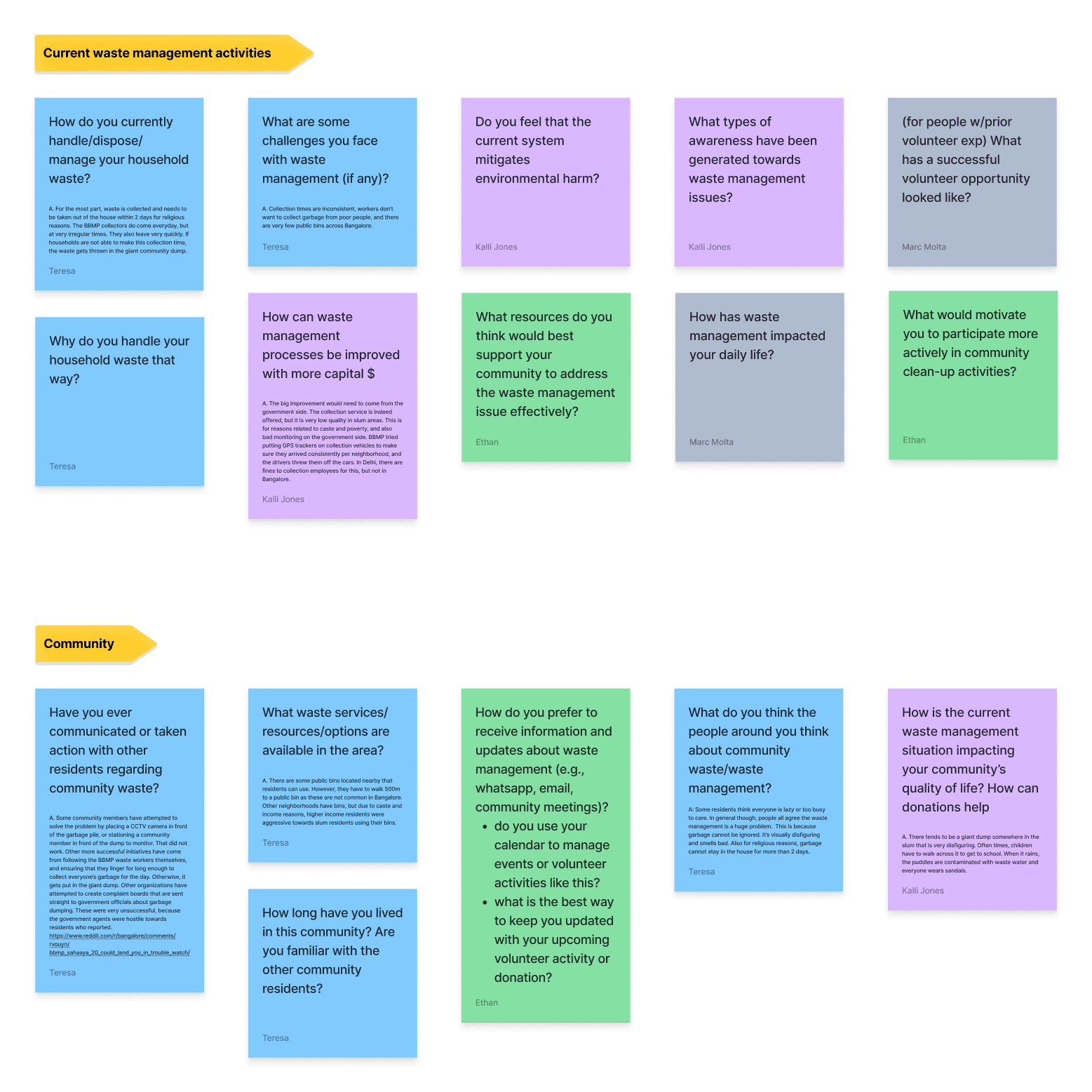
Due to physical and technical limitations, we were unable to directly connect with Bangalore community residents. So, we consulted Emma Zhang, who shared her extensive fieldwork insights on waste management in low-income communities in India. Our team also reviewed past and ongoing research papers on Bangalore's waste management, solid waste systems, and the informal waste sector, as well as analyzed Emma's community visit notes from Koramangala and Madiwala, two neighborhoods within Bangalore.
To better understand our client and community members' needs, we focused our research on two goals:
Learn about residents’ current behaviors, motivations, and pain points with waste management
Explore the roles and capabilities of community volunteers and explore how EPIC can provide support.
After our initial meetings and discussions with Emma, we gave her interview questions for her to ask Bangalore community members about their current situations during her on-site visit, allowing her to promptly provide us with their responses.
An important note we discovered was that because residents in these areas mainly used Android phones with 5G connection, our priority became creating a mobile platform that would be optimized for low bandwidth content and high visibility.
Ideation
Defining end goals
Our team then held several meetings with Emma and EPIC India to establish a roadmap and list of product needs and features to keep in mind during the design process.
Required Features:
Nearby Community Cleanup List
View details and information about cleanup initiatives in nearby communities.
Volunteer Sign Up
Register/onboard as a volunteer and provide basic contact information.
Send Donations
Support supplies and stipends for volunteers to successfully clean up a neighborhood.
Community Forum
Engage with nearby neighbors in discussions about managing and maintaining waste.
Organizing structure and basic layout
Before diving into the design, our team created a framework that organizes content and functionality, ensuring seamless navigation and clarity for the users.
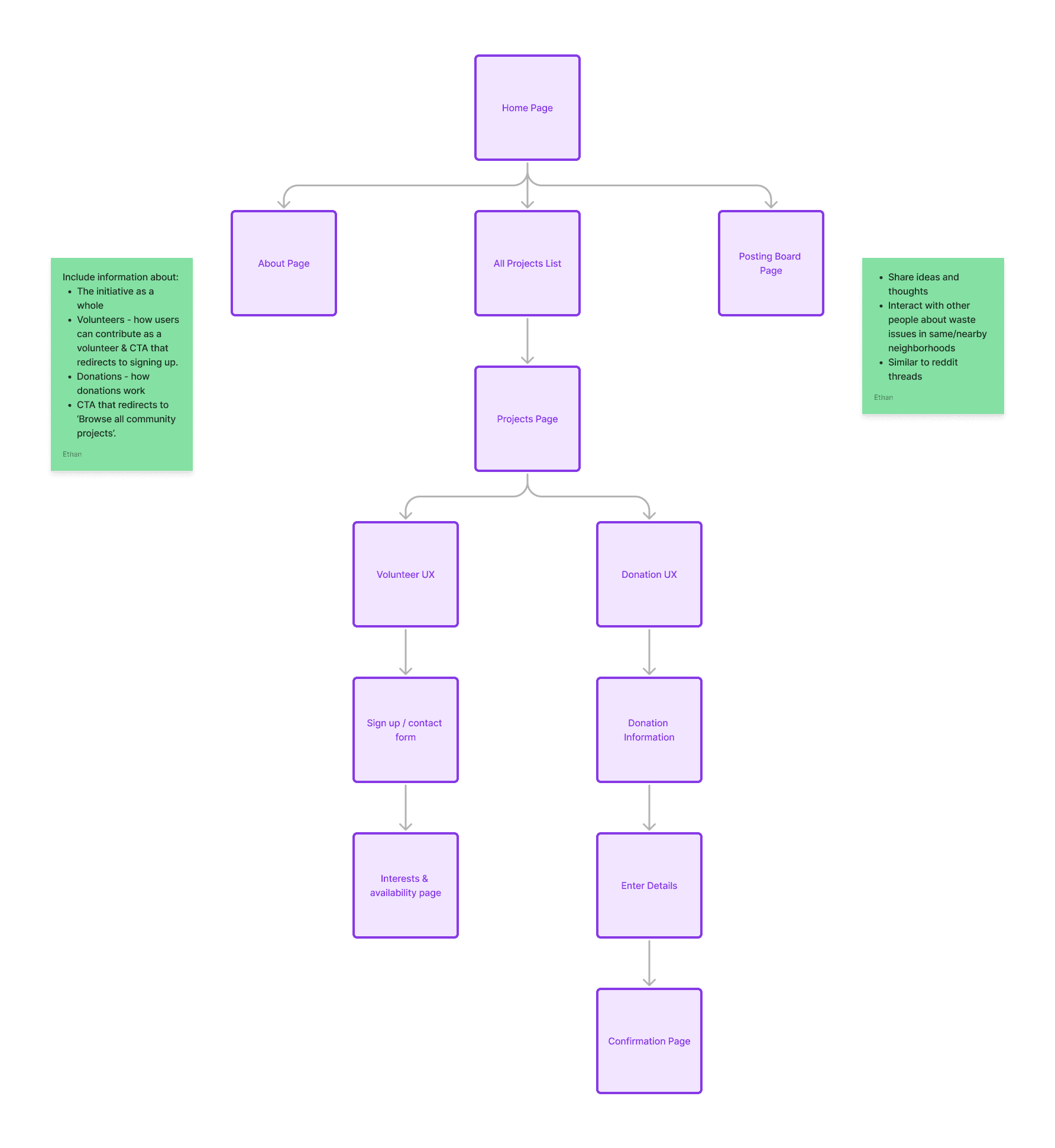
Our team decided that the most efficient approach was to divide into pairs to address the pages collaboratively. My partner, Teresa, and I were assigned to work on the home page and the donation flow pages. Each pair began by mapping out a user flow specific to their assigned pages and then moved to creating some basic wireframes.
Different Idea Paths
Home Page
is for community members to easily understand EPIC India’s mission and find out how to get involved.
Donation Pages
are direct and intuitive so that community members can clearly know where their donations are going.
Volunteer Pages
are location based so community members have a place to learn about or join a cleanup as a volunteer.
Forum Pages
are for community members to interact with their neighbors and raise awareness about waste issues.
Development
Prioritizing simplicity and ease of access
As we moved towards mid-fidelity and high-fidelity prototypes, we came back together and met as a team to collaborate on creating a design system for our application so that all of our pages could look cohesive.
Something about the website design
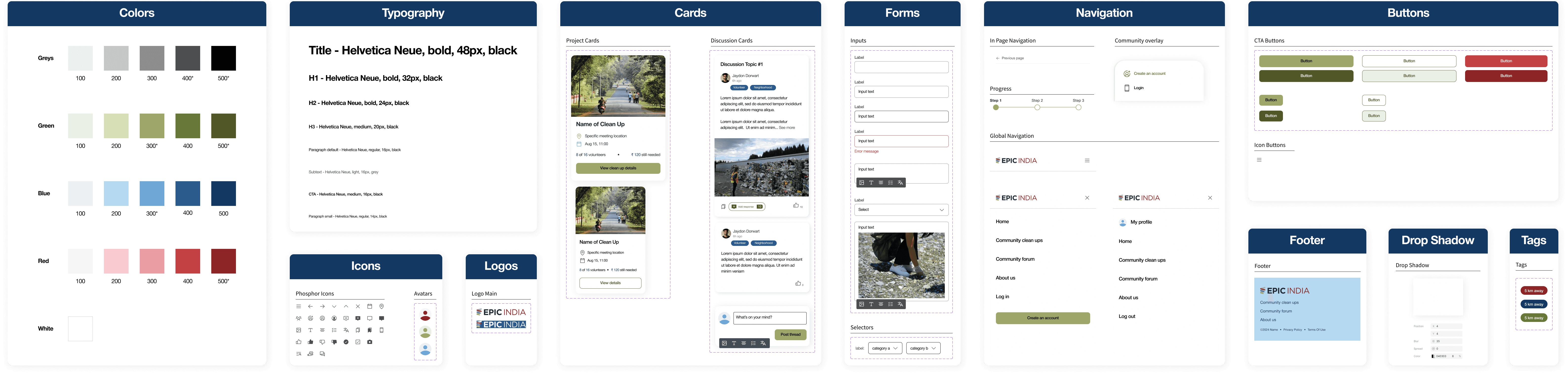
Balancing design and information
Something about the card designs
Creating engaging interactions
Something about the 3D models
Iterations
On the right track!
We conducted user testing of our mockup designs on UserTesting.com, where 15 users provided us with comprehensive video feedback. Additionally, we were fortunate to have our client, Emma, on-site in Bangalore. She was able to moderate 4 more in-person user tests to Bangalore residents using our updated prototypes to give us more feedback.
The following is how we modified our designs based on this feedback:
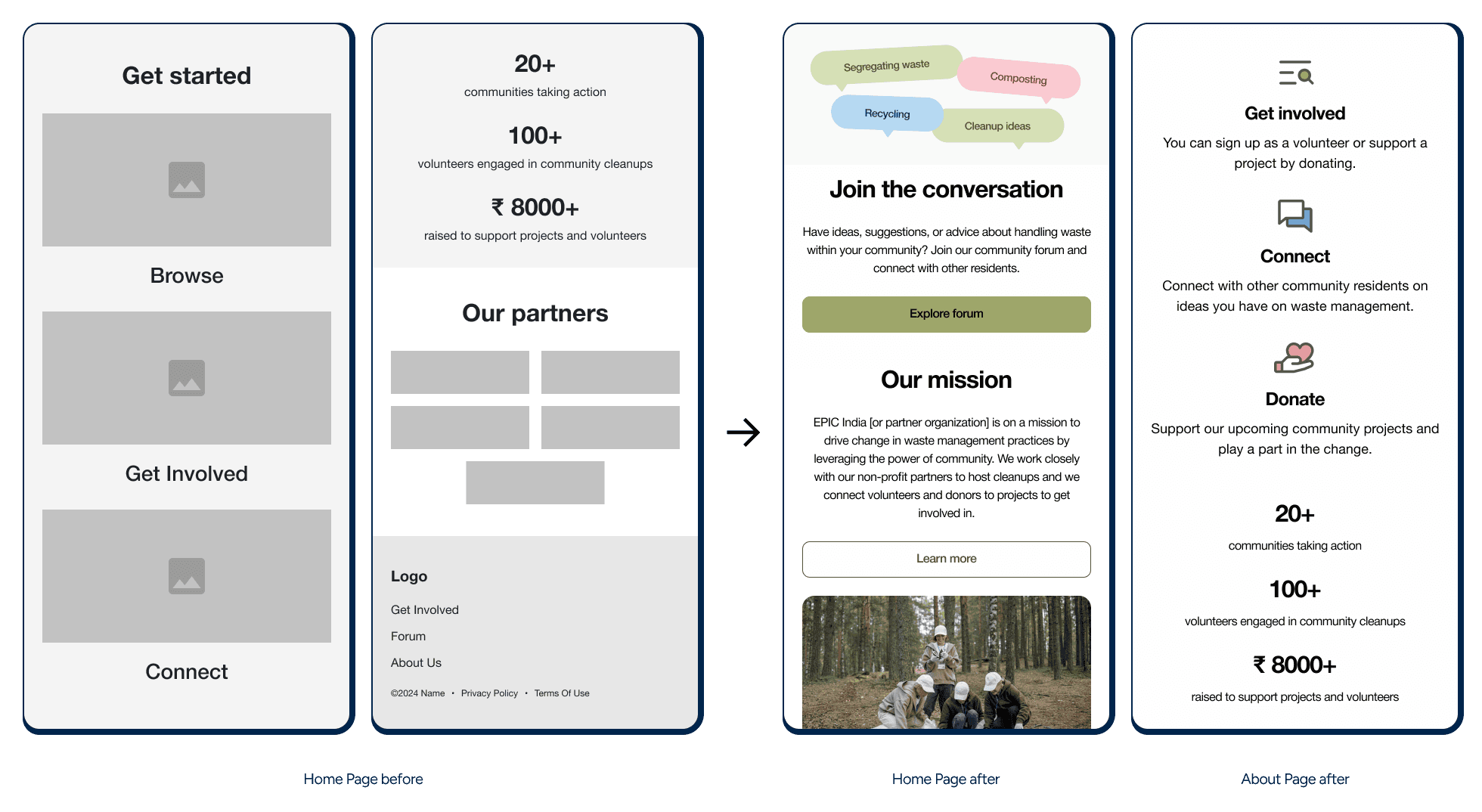
Home and About Page
After conducting our first round of user testing, we realized we needed to separate out some of the information from the home page and put it in an about page to keep the main page less cluttered.
We designated the home page as a broad introduction and the about page for more detailed information about the project.
We also reordered sections to create a smoother flow and simplified some of the information to reduce redundancy and avoid overwhelming users.

"I felt that the information on the main page was a bit repetitive and I might clean that up a bit."
- Anonymous User Tester
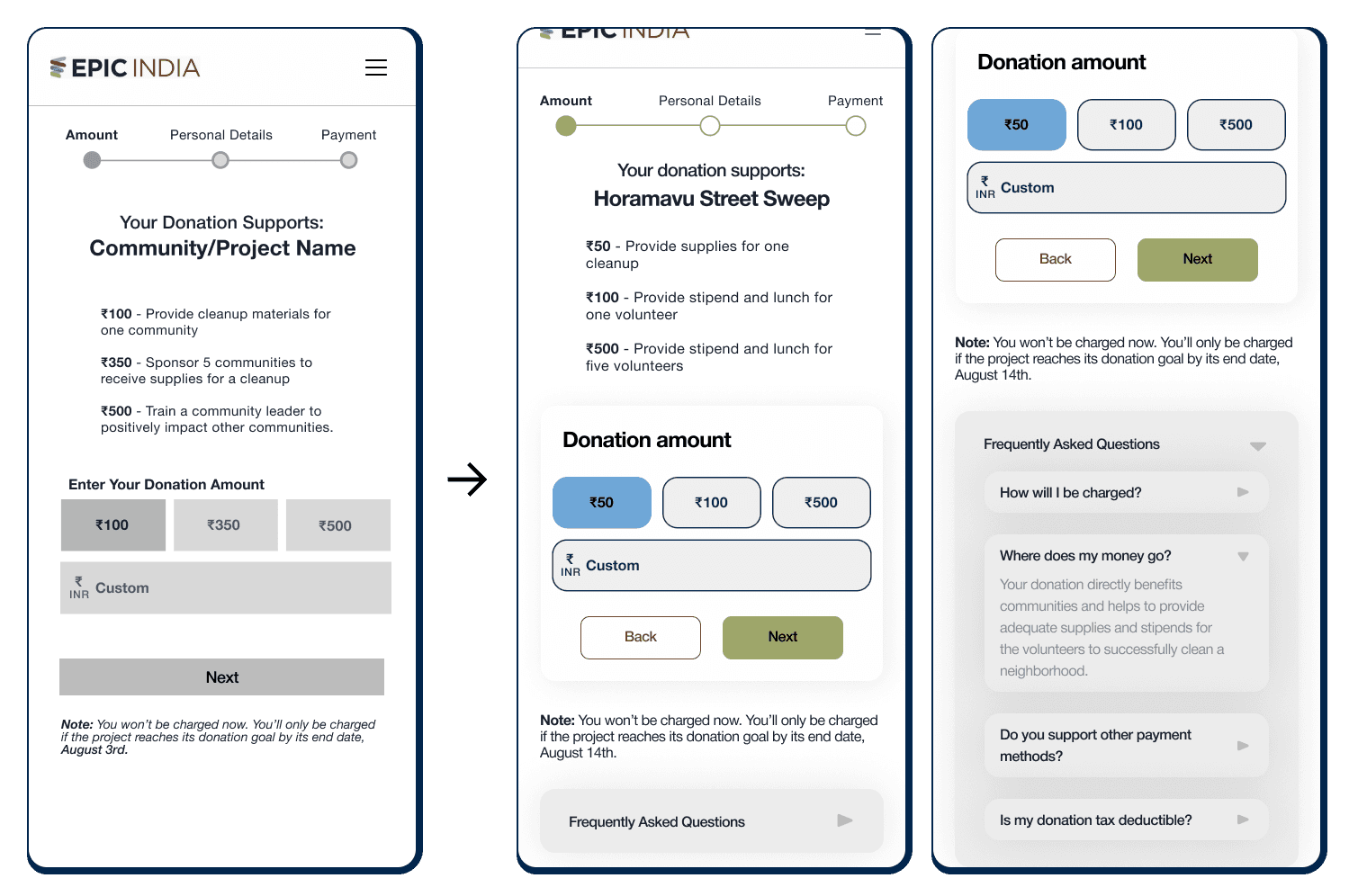
Donations Page
After our first round of user testing and a couple of client feedback meetings, we found that some users expressed a desire for more information, particularly regarding where the donations would go towards.
Following the feedback, we included an additional FAQ section as a part of the the donations page to explain how the donations would be used.
We also updated the wording of the confirmation page to be warmer and more appreciative.
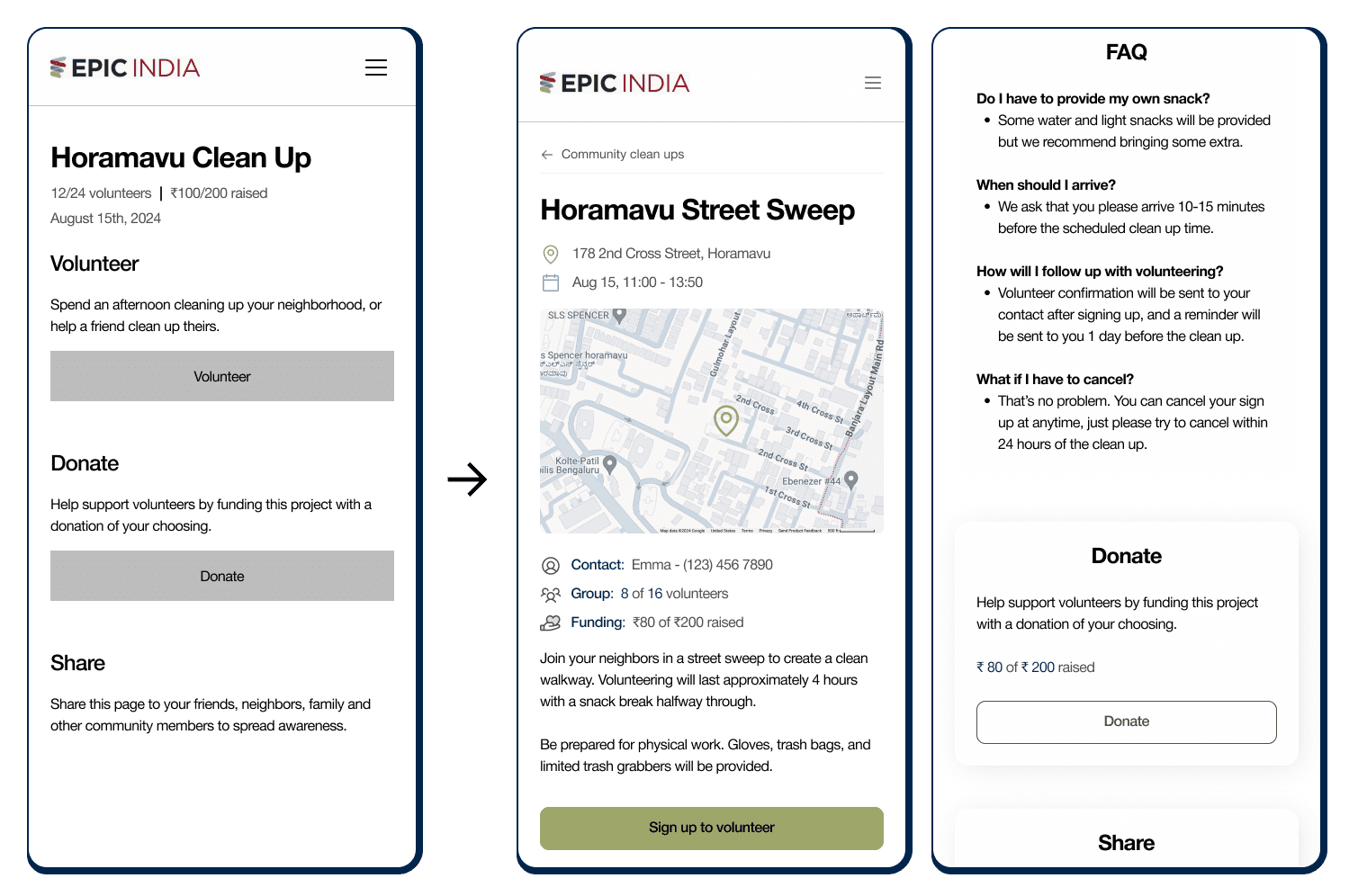
Volunteer Page
Again, after our first round of user testing and a couple of client feedback meetings, we realized that the volunteer page could be modified to include more information about the project.
To be more clear, we included a brief description of the project outlining physical work requirements, a small map for the exact location, and contact details for the project lead. Additionally, we made the number of current volunteers (out of the maximum allowed) and the amount of donations raised more prominent.
We also improved the confirmation page to display all relevant information clearly, including the time, location, date, physical expectations, and an easily accessible cancellation button for users who may have changed their plans.
To speed up the process, we also implemented a feature for logged-in users to auto-fill previously entered details.
"I would want to see more information about the project before I sign up."
- Anonymous User Tester
Final Deliverable
The final station!
01
Clean and simple information
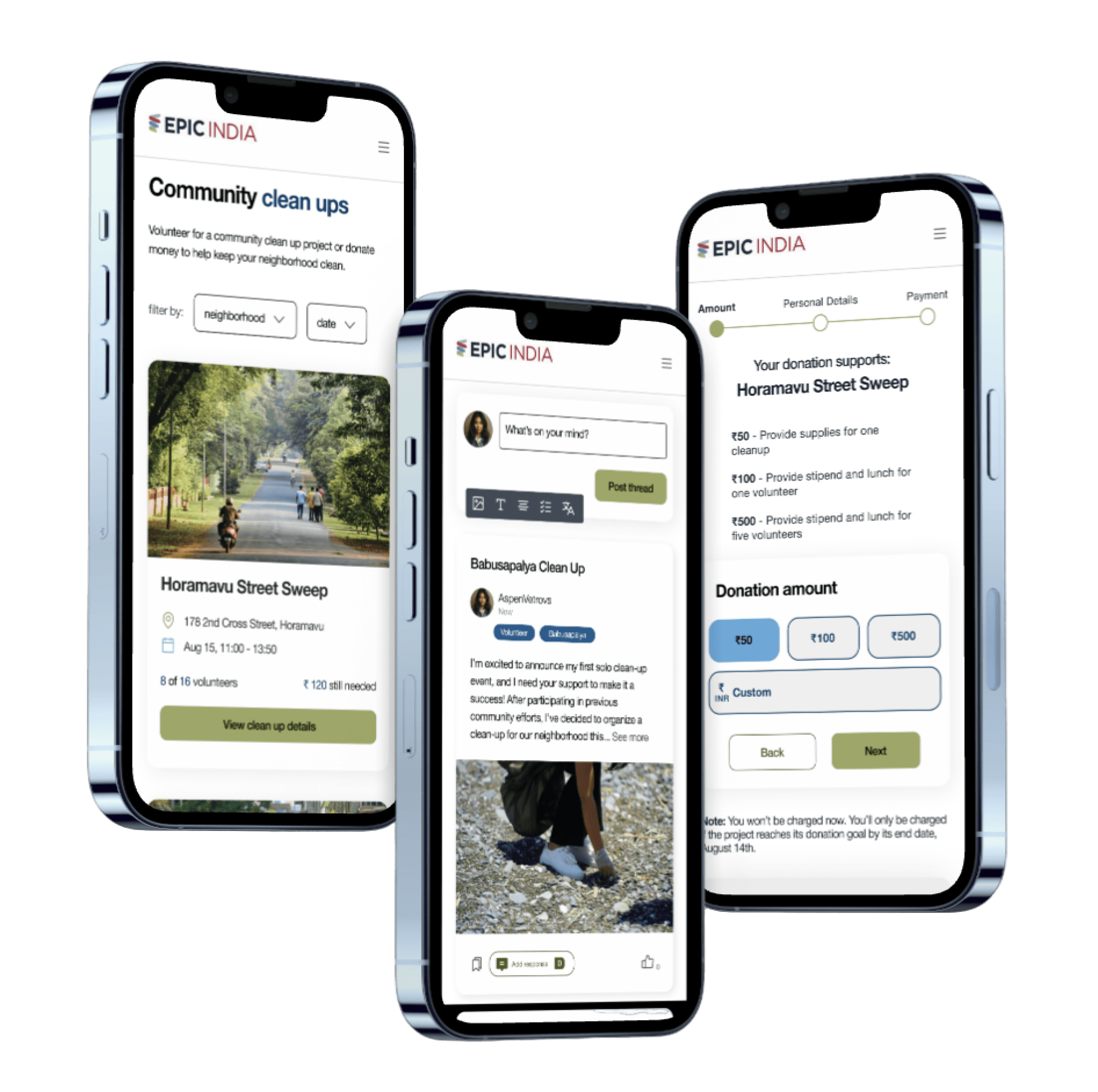
Home page - browse the organization’s mission and overview.
About page - understand the bigger picture and why it matters.
Learn about how to get involved with CTA to easily maneuver the platform!


02
Browse community projects and sign up to volunteer
Community projects list - view cleanup initiatives in nearby neighborhoods.
Project page - easily view specific project details and join as a volunteer or send a donation.
Autofill information - logged in users can volunteer for projects easily
Profile page - sign up and keep track of volunteer history
03
Donating to the cause
Send a donation to support supplies and stipends for volunteers to successfully clean up a neighborhood!
FAQ section and preset donation amounts are to outline exactly where the money is going with full transparency.
Profile page - sign up and keep track of donation history


04
Connect with your community
Engage with neighbors in discussions about managing and maintaining waste in your shared community.
Encourage participation and raise awareness for cleanup initiatives.
Testimonials
Signals of success!
Our team successfully designed a simple and streamlined platform to address EPIC India’s vision of improving and maintaining waste management practices in Bangalore. Our design is now handed off to developers and when it is officially launched, this platform will have the potential to scale and impact hundreds of low-income communities.
Across feedback from 20 users, we achieved:
100% completion and success rate across all the tasks completed in our usability tests
97% user satisfaction across all the tasks from our user tests
15 users praised the platform and described its design as “simple”, “straightforward”, and “easy”
In-person user testers indicated their desire and need for this type of crowdsourcing/cleanup platform for their own community:

“This is an awesome app, well designed and intuitive and easy to use. I wish I had it in my area.”
- Anonymous Bangalore Tester 1
“I really like the idea and would love for something like this in my area”
- Anonymous Bangalore Tester 2
“Loved the idea, the simplicity won me over and made me feel like I was going to help a good local cause. Love the theme!”
- Anonymous Bangalore Tester 3